

Many boat owners assume that boat length determines the size of motor they need. That’s a reasonable assumption, but boat length alone doesn’t tell you the whole story.
An 18-foot aluminum fishing boat, an 18-foot pontoon, and a heavily equipped offshore fishing boat can have very different horsepower requirements because the boat’s weight, hull design, passenger load, and intended use all matter.
Where you plan to boat matters, too. A boat used on a calm inland lake has different demands from one used for salmon fishing on Puget Sound or making longer offshore runs.
So, how do you know which motor to buy? Here’s how you figure it out.
Start With the Boat’s Maximum Horsepower Rating
Before anything else, you’ll want to check the boat’s capacity plate or the manufacturer’s specifications because this tells you how much power the boat is designed to handle.
A boat’s capacity information can include its maximum horsepower, maximum passenger capacity, and maximum weight capacity. The U.S. Coast Guard advises boaters not to exceed the capacities listed on the boat’s capacity plate because doing so can be dangerous.
These numbers also work together. Adding passengers, fuel, fishing equipment, and other gear increases the boat’s total weight, which can affect how much power you need for good performance.
The maximum horsepower rating isn’t necessarily the horsepower you need. Think of it as the upper limit for the boat. Within that limit, the right choice depends on the hull, typical load, and what you plan to do with the boat.
Small Aluminum Boats: When 9.9 to 40 HP Makes Sense
Smaller aluminum fishing and utility boats don’t necessarily need a large outboard. An engine in the 9.9- to 40-horsepower range provides plenty of power for a lightweight boat used on a small lake or protected bay.
This range can be a good fit for activities like light fishing and general recreational boating, and it’s also common to see smaller engines used on boats that need to be easy to launch and transport.
Mid-Sized Fishing Boats: 50 to 115 HP
Once you move into larger fishing boats, the 50- to 115-horsepower range covers a lot of common applications. These engines can provide a useful balance of performance and versatility for boats used for fishing and family recreation.
That’s an important point when choosing an outboard. If you’re going to cruise and carry several people and plenty of gear, you don’t want to base your decision on the weight of the empty boat. Think about how you’ll actually use it.
A useful Pacific Northwest example is a compact aluminum fishing boat carrying two or three anglers, fuel, tackle, a cooler, and crabbing or salmon gear. That real-world load can make a meaningful difference in how quickly the boat gets on plane and how comfortably it holds speed. Boat Country’s Stabicraft boats provide examples of fishing-focused hulls paired with appropriately sized outboards.
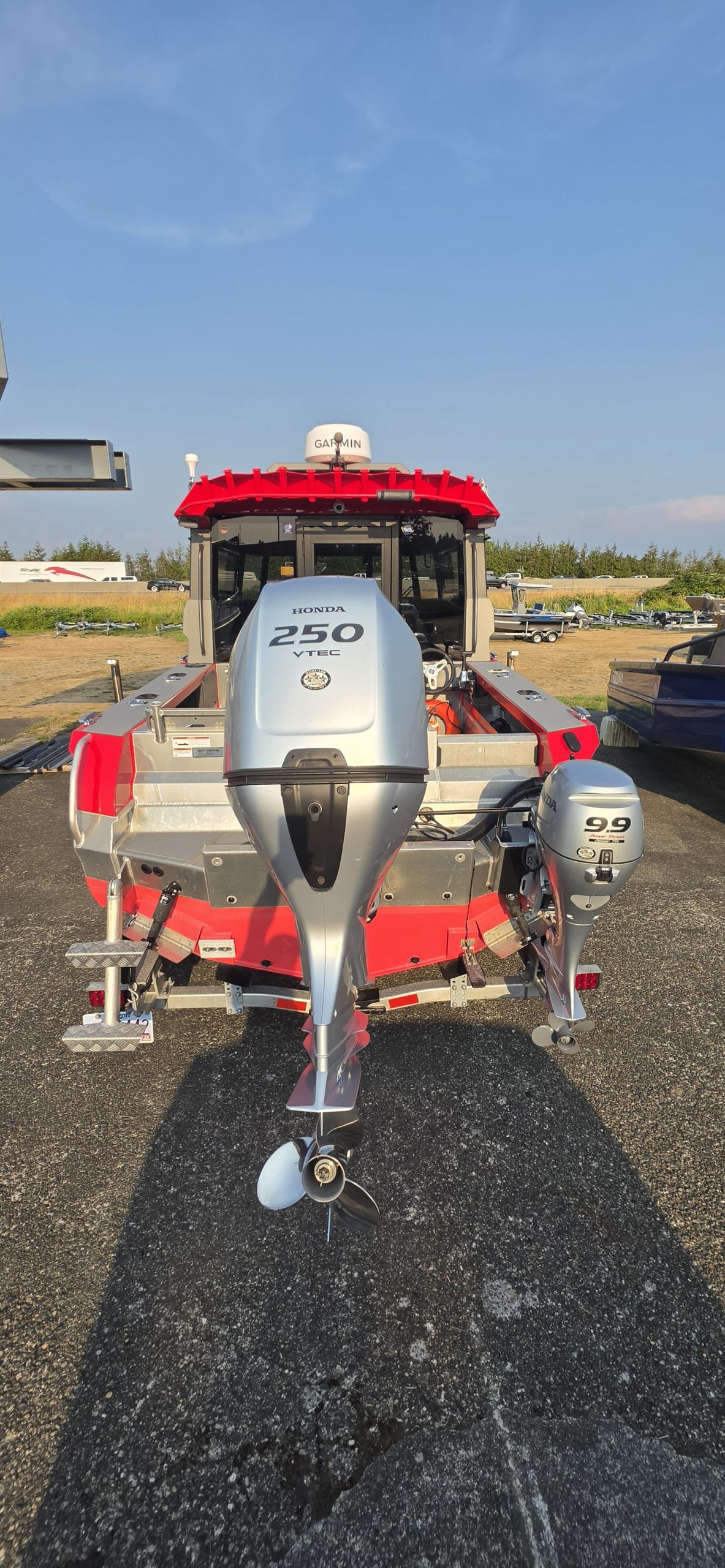
Larger Fishing and Offshore Boats: 150 to 250+ HP
Larger fishing and offshore boats bring different requirements. A larger hull can carry more passengers, fuel, equipment, and fishing gear, while rougher water can place additional demands on the boat and its propulsion system.
That’s where you start seeing outboards in the 150- to 250-plus-horsepower range.
Larger offshore boats may also use twin outboards. Two engines can provide additional propulsion and redundancy, but the boat must be designed and rated for that configuration. If you’re shopping for a complete package rather than repowering an existing hull, comparing new fishing boats with the motor already matched to the boat can simplify the decision. It also lets you evaluate the hull, engine, controls, fuel capacity, and intended use as one system instead of choosing horsepower in isolation.
Don’t Assume Less Horsepower Always Means Better Economy
Choosing too little power can be frustrating on a boat that regularly carries heavy loads. An underpowered setup may have to work harder to get on plane and maintain cruising speed. The better goal is an engine that operates comfortably within the boat manufacturer’s rating and matches the load and conditions you actually expect to encounter.
How Does the Water You’re Boating On Change the Equation?
The Pacific Northwest gives boaters many different environments to explore. You might spend one weekend on a small inland lake and the next heading out on Puget Sound. Those situations can call for very different boat and engine setups.
- Lakes and protected inland water: Smaller, lighter boats with moderate horsepower can work well in places like Lake Washington and Elliot Bay. If you’re mainly fishing or cruising in relatively calm water, you may not need the same power as someone making long coastal runs.
- Puget Sound and coastal waters: Conditions can change quickly. Tides, currents, wind, and chop all become part of the equation, and adequate power can be important when you need to maintain control and make headway in changing conditions. But remember that a larger engine doesn’t make an unsuitable boat safe in rough water. Hull design matters just as much.
- Offshore fishing: Longer trips and heavier loads can increase the demands on the boat and its propulsion system. As a result, if you head to offshore areas like Westport or Neah Bay, larger fishing boats and higher-horsepower or twin-engine setups can make sense.
You’ll want to choose a boat that matches your lifestyle, and from there, it becomes easier to select the right motor.
What About a Kicker Motor?
For many Pacific Northwest anglers, the main outboard isn’t the only engine to consider. A smaller kicker can be useful for trolling and can provide an additional propulsion option on larger fishing boats. The correct kicker size and mounting arrangement still depend on the boat’s transom, weight, steering setup, and manufacturer recommendations.
Repowering an Existing Boat
If the hull is still a good fit but the motor is aging, repowering can extend the useful life of the boat without replacing the entire package. A repower is also a good time to review engine weight, controls, rigging, propeller selection, and whether your current horsepower still matches the way you use the boat. Boat Country’s outboard team services and sells Honda Marine outboard motors and Yamaha Marine outboard motors engines and can help evaluate the existing setup before a new motor is selected.
Choose the Whole Boat-and-Motor Package
The right outboard isn’t the biggest one your boat can handle, but rather the one that provides the performance you need while staying within the manufacturer’s specifications. You’ll need to consider your boat’s size, water conditions, typical load, and how far you plan to travel before making your decision.
If you’re comparing a repower with replacing the boat, reviewing Boat Country’s used boats for sale can also help you compare the cost and capability of both options.
Boat Country carries a broad range of Honda and Yamaha Marine outboard motors and can help match an engine to your boat and the way you plan to use it. Contact us to learn more or stop by our Showroom in Everett, WA.